Miracles or Deceptions?
How I Navigate Skepticism in a Culture of the Miraculous

I don’t know when my skepticism of miracles began, or why.
I was raised going to parochial school and hearing Biblical stories of miracles and I never doubted their authenticity or reality. I still don’t. I never bought into the Jesus Seminar deconstruction of the Gospel miracles, like the multiplication of the loaves and fishes was the crowd being shamed (or encouraged) by the young boy offering to share his lunch so everyone pulled out their hidden food and shared it. I didn’t need a meteorlogical explanation of high wind and low tide to believe the Red Sea parted for Moses. The rationalistic and scientific explanations of miracles always seemed more contrived and fantasmagorical to me than the original story as it is told in Scripture.
So, in 1969 when I was seventeen, I converted from Catholicism to the Jesus Movement where miracles abounded. Shortly after that I got involved in the churches of Christ which is a cessationist tradition. They believe that the power to perform miracles through human agency ceased when the last Apostle died, though God is still capable of effecting one directly. No one was ever really able to tell me the difference between God answering my prayer miraculously and God healing someone by the laying on of my hands, both human agencies. But, I digress.
Back to the Jesus Movement. I always felt like an outsider among my fellow Jesus Freaks. All my friends spoke in tongues. They told me to pray for the gift. I prayed. Nope. “You have to just start and the Spirit will move your speech.” And they would give me “starter syllables” (more than one “Jesus Person” has noted they sounded a lot like “Sallyrodeahonda”. Google will reveal lists of “tongues syllables”.) But, I wasn’t willing to fake it. So, I never spoke in tongues.
I remember sitting on the green shag carpet in a crowded living room as a long haired, glassy eyed Bible study leader talked about audibly hearing the voice of God that lead him to do this or that, reveal things to him to prophecy to the group like, “Walk with the Lord” or “Jesus wants to live in your heart”. Everyone would close their eyes and raise a palm toward heaven mumbling “Thank you Jesus, praise Jesus, thank you Lord”. Even though I also had long hair, John Lennon glasses and was a “Jesus Person” like him, I felt faithless and like a judgmental jerk because, as he was speaking, I was sitting there thinking, “C’mon people, this guy has dropped more acid than a pool cleaning service. He’s so fried he wouldn’t know the voice of God from a K-mart blue light special announcement.”
And there was always “sharing” whenever Jesus People got together. I remember one story in particular about a church picnic football game where someone knew a friend who was at the game where someone got tackled and suffered a compound fracture of his leg. “The bone was STICKING OUT!” The players gathered around, laid hands on him and prayed, and the bone WENT BACK IN! AND THEN he got up and played the rest of the game with no ill effects! I never asked why 90% of the miracles happened to people who knew someone who was “there” when it happened. But the person who was “there” was seldom, if ever “here”. Not that I thought they were consciously lying (after all, why would they lie?), but I just couldn’t bring myself to believe the second (or third, or… well, ad infinitum) hand stories for some reason. In the church of Christ if you witnessed or experienced a miracle you didn’t share it openly because it might lead to speaking in tongues.
So, over the years, even as a cessationist, I felt guilty and even a little ashamed for being so unbelieving and skeptical. Now and then I prayed for an undeniable miracle to happen before my eyes so I would not be so doubting and perhaps even deemed faithless. By the time I became an Episcopalian at about age 40, I had heard dozens of second hand and a few firsthand accounts of miracles but still had not personally witnessed or experienced anything that was undeniably a divine intervention like a polio victim being straightened or a blind man seeing instantaneously. I’d heard lots of the more garden variety of miracles like cancer mysteriously disappearing between PET scans, people getting “premonitions”, survival stories, and “wild coincidences”, all attributed to divine intervention. But the problem for me was that most “garden variety miracles” were things that happen even to unbelievers. It always seemed to me to be somewhat triumphalistic to claim it was our faith in God when atheists experienced spontaneous remission of cancer, unexplainable recoveries, and wild coincidences too. Over the years I could not force myself to manufacture belief in an undeniable miracle out of an unexplainable event, or some “normal” anamoly of science, or medical mystery that happens to people regardless of religious affiliation or even belief in God or a god.
So I had left the rationalistic churches of Christ and became Episcopalian. Part of moving on from the David Hume inspired rationalism of the churches of Christ was because I had begun reading the great Mystics of the Church. I was more open to the possibility of divine intervention than ever in my life. The Episcopal Church my wife and I joined had a priest who was into the Protestant charismatic healing movement. He was big on the Vineyard Movement and Francis MacNutt, a Roman Catholic faith healer. One weekend we had a “healing event” which featured Francis MacNutt, and a local Vineyard pastor. Our parish’s charismatic “healing ministry team” was part of the healing services. A couple hundred people showed up for the mini-Benny Hinn experience.
During the course of the night people spoke in tongues, lined up to get whacked on the forehead, were slain in the spirit, fell down, cried and laughed uncontrollably… all the usual things you see on TV. It seemed like it was almost scripted it was so “usual”. Several people in our parish came and they were “healed” of the afflictions our members all knew about. A child’s leg grew before their eyes. A man’s club foot “felt like it was getting better”. Various diagnosed and undiagnosed illnesses were healed. Emotional traumas were removed.
A middle aged man in shorts and a short sleeved shirt came forward. He twitched uncontrollably and his head spun around the room as if he was surrounded by Ninja assassins. He had a red, scabby skin condition, perhaps a case of severe eczema, as close to looking like a leper as you could imagine. The healing team sat him in a chair up on the altar area. They all gathered around him and laid hands on him (on his clothing, actually. There were no latex gloves for faith healers). One woman on the team stood behind him. She was short so her ummmm… ample breasts sat on top of his head as she laid her hands on his chest from behind the chair. She had her eyes closed, her face raised to heaven and spoke in tongues with the rest of the team. Every once in a while someone on the healing team would ask him, “Do you feel the Spirit moving?” The man would say, “Yes….., yes…” then timidly, “…I think so.”
My skeptical unbeliever friend Joe, who was looking for his own personal miracle too, leaned over and hissed loud enough for half a pew all around us to hear, “Of course he does, I’d feel the spirit too if her ***** were on my head.” The man walked off the stage, still twitching, still scabby and we never saw him again. Four weeks after the healings no one talked about our members who were “healed”… the still clubbed foot, nor the surgery to correct the child’s still short leg, nor the ongoing medical treatments for various ailments, and therapies for traumas.
So, my six years of Vineyard and Francis MacNutt ministry experiences in the Episcopal Church only reinforced my skepticism. I still felt faithless and like a wet blanket on the tongues of fire of the Holy Spirit. And I felt smugly superior to the “healers” that I perceived as sincere but deluded, or egoists, or marginalized outcasts who were just trying to fit into an elite club in the parish.
Then I became Orthodox. And I found out the Orthodox Church believes in miracles.
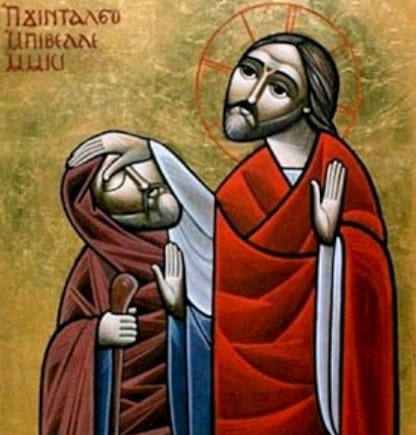
I mean, it REALLY believes in them. The Church has “wonder-working” saints, holy oil dripping icons and relics that heal, holy Elders that can levitate and be in two places at once… I could go on and on. The Holy Spirit is alive and well in the Church. So “BAM!” my issues with the miraculous just got kicked up several notches. It seemed I had to buy into all kinds of miraculous occurrences that I’d never heard of in my Protestant experiences: icons that weep myrrh, dead people that don’t rot and smell like roses, dead saints that wear out the shoes put on their feet, holy fire that spontaneously appears and lights thousands of candles on Pascha night in the Holy Sepulchre. And, again… I heard the stories and I know just about everyone believes them because well… just about everyone believes them. Why would people lie about miraculous events? If someone doesn’t believe in them, they sure don’t speak up, at least not in public.
But like before, I’ve never seen any of it with my own eyes. And my feeling of being a fringe dweller and a curmudgeonly faithless jerk yet again kicked up several notches. It was like being in the Jesus Movement or in the pew watching Francis MacNutt and feeling like, to be accepted, I had to play “pious” and mumble “Glory to God”, which seemed to me to be the Orthodox cultural version of the lifted palm to heaven and whispering, “Thank you Jesus” while feeling unholy.
It took me a lot of years, but I finally figured out the real issue for me. It was not that I disbelieve the possibility of miracles, it was that I doubt the judgment and discernment of the people who claim they saw or experienced one, or second hand reported them. How DO we know we should be thanking Jesus or God for what we think we saw or experienced? Just because it was “miraculous” doesn’t make it “from God”. St. Paul and Jesus himself say Satan and false christs and prophets can work lying wonders that will deceive believers. (2 Thess. 2:9, Matt. 24:24), But even with that clearly in the Scriptures, I had never seen anyone in 55 years of Church experience question whether something miraculous was of God or Satan.
But, when I delved further into the miraculous in Orthodoxy, I discovered something refreshing that my skeptical self really likes about Orthodoxy: The Church actually encourages us to view the miraculous with caution even if pious individual Orthodox people don’t. It teaches us to be skeptical and to be discerning of alleged miracles because it takes seriously the warnings of Christ and the apostles of the possibility of demonic delusion and “lying wonders”.
My best friend (who is also a former church of Christ miracle skeptic) was at an Orthodox youth summer camp where icons started weeping. Even though he called me the night it happened, the news of it didn’t spread like the spiritual wildfire one would think would happen. When the priest in charge of the camp was asked about what it meant he just said, “We don’t know what it means, we’ll see what fruit it bears” and just went on with camp. I liked that a lot. Of course “fruit bearing” can also be a tough thing to discern too. It assumes the spiritual qualifications to judge fruit. Years ago I heard of a “monastery” in Texas that had a phony “weeping icon” that drew thousands of pilgrims (clergy and laity) and helped them raise hundreds of thousands of dollars and it basically funded their monastic pedophilia ring. I wondered how thousands of pious people and even clergy could be duped over a period of years? If you express skepticism (or even just being un-impressed) you might get the holy side-eye. Sometimes it seems, in some circles, that gullibility is a fruit of the Spirit.
A few years ago in my area it was announced that there was a traveling priest with a gold reliquary cross that contained a piece of the “True Cross” with the blood of Christ on it. He was from Cyprus (or several other places depending on who I talked to). He was appearing at a local monastery and then at a local parish doing healing services with it. (I didn’t go, it sounded too much like Steve Martin’s traveling miracle sideshow in “Leap of Faith” the way it was promoted. A very good movie, by the way). The story was, he was given the relic by a woman who handed it to him and told him God told her to give it to him. But…another story is that his mother gave it to him. Both stories are from people who claimed to have talked to him personally. I think this is how some hagiography gets written… Anyway, he somehow discovered its healing powers and began traveling doing healings.
The relic is embedded in a heavy, large gold cross and when he puts it on people’s bodies it “sticks” to the places that need healing. He can remove his hand from it and it stays put, defying gravity. Hundreds of people flocked to the monastery and then to the parish for healing. There were “miraculous” things that I was told that sent my skeptic meter into the red zone. One thing was that he seemed to “know” things. But according to the Desert Fathers, “knowing things” isn’t always a good thing.
I met someone who “knew things” about 35 years ago. On our Sunday night hang out on Mill Avenue near Arizona State University, a group of buddies and I paid five bucks to have our Tarot read by a street gypsy… just for grins. As she turned over card after card, she revealed my life… waaaay too specifically to be mere “astrology or Fortune Teller cold reading coincidences”. The rest of the guys will attest. They knew what was going on too.
I didn’t know how she did that until I became Orthodox years later. It was a “miracle”, but a demonic one. You see, the Fathers teach that demons know what “is”. They cannot tell the future (but are good at guessing after tempting humans since creation), but they can reveal real events that HAVE happened to people and what they are doing NOW. She clearly knew what I was doing. In the writings of the desert Fathers, there are stories of monastics who were drawn into prelest and delusion because they thought they were clairvoyant, but in reality they were being fed information by the demons so they would fall through pride and their desire for followers and admiration. The stories usually go that they and everyone around them was fooled by the miracle and drawn away from the faith by the deception… except for one person (usually a holy elder) who saw the imperceptible signs of delusion and demonic captivity. So as St. Ignatius Brianchaninov warns, not even clairvoyance whether it is a gypsy or a monastic elder is a sure sign of godliness. It can be demonic manipulation.
Anyway, back to the gold cross… those who attended the “True Cross” healing sessions said they were moved. They were amazed. They were uplifted. They “felt the grace”. OK, my skeptic self thought, so you felt something you thought was “grace”. So does that make it of God because you felt it and thought it? No. It just means that’s how you perceived it. Am I willing to accept the witness of someone “feeling the grace” as affirmation of the presence of the Holy Spirit? Frankly, (as you probably gathered by now): No. (And as an aside, I would not even accept MY OWN feelings as affirmation of the presence of the Holy Spirit. I’ve felt a lot of things in my life that turned out to be passions rather than piety. I’ve had plenty of spiritual feelings and leadings in my life and after living the with consequences of acting on them, I hope to never have one again.) The Scriptures and the Fathers say that Satan sends a strong delusion into the Church to lead people astray. Of course the “most convincing demonic miracles” would happen in the Church. Satan appears as an angel of light, not like Batman. Why send a strong delusion to unbelievers when a weak delusion will do the trick? Save the real hard work for those who have faith.
So, as for me, I’m perfectly content to not praise God immediately regarding a miracle. I’m perfectly OK with sitting back and waiting twenty or thirty years to see what kind of fruit some miracle brings forth. In the meantime if God wants to kick the skepticism out of me, I’m sure He knows where to kick me and how hard. The thing is, I don’t feel deprived of any “spiritual joy” nor do I believe the Gospel any less because I am skeptical of miracles, even ones affirmed by thousands of pious people across church history. I am content to believe if God did a miracle in someone’s life it doesn’t matter if I believe it or not. It is what it is and it is between that person and God. We’ll see what fruit it bears in the long run. Miracles don’t make me any more in awe of God or any more or less faithful one way or the other. As Christ said to Peter when he questioned the miracle of John not suffering death, “What is that to you, you follow Me”. Other people’s miracles are not my business.
However, even if they are not my business, they are because they happen. So, I do know that when it comes to miracles, there is safety in caution and dire consequences for gullibility. There is a big difference between attributing everything to God, or everything to Satan, and being unwilling to make pronouncements one way or the other because I don’t trust my own judgment nor the judgment of other people to discern the difference. Of course I realize that I could be completely wrong about all this miracle stuff and its my own fault if I am missing out on a blessing because of my skepticism. But, I’ve never been one to go out of my way to seek out or pray for special or extraordinary “blessings”. I, for some reason, have always just believed mine come in my day to day walk with God. All I have to do to be blessed extraordinarily is pay closer attention.
So, you may say “But miracles are part of the Church! They are important! How can you be truly spiritual and not believe them?”
I’ve always liked G.K. Chesterton’s take on miracles*. He sums up my thoughts very nicely. He says:
No religion that thinks itself true bothers about the miracles of another religion. It denies the doctrines of the religion; it denies its morals; but it never thinks it worth while to deny its signs and wonders.
And why not? Because these things some men have always thought possible. Because any wandering gypsy may have psychical powers. Because the general existence of a world of spirits and of strange mental powers is a part of the common sense of all mankind. The Pharisees did not dispute the miracles of Christ; they said they were worked by devilry. The Christians did not dispute the miracles of Mahomed. They said they were worked by devilry. The Roman world did not deny the possibility that Christ was a God. It was far too enlightened for that.
In so far as the Church did (chiefly during the corrupt and skeptical eighteenth century) urge miracles as a reason for belief, her fault is evident…. It is not that she asked men to believe anything so incredible; it is that she asked men to be converted by anything so commonplace. What matters about a religion is not whether it can work marvels like any ragged Indian conjurer, but whether it has a true philosophy of the Universe. The Romans were quite willing to admit that Christ was a god. What they denied was the He was the God - the highest truth of the cosmos. And this is the only point worth discussing about Christianity.
And I thank God nothing more or less than this is required of me to be truly Orthodox.
*The Religious Doubts of Democracy (1904) and “The Blatchford Controversies” (in The Collected Works of G.K. Chesterton, Vol. 1).
So glad you bring this up, Steve. When I was a catechumen, some Charismatic friends laid hands on me in their home, praying for me to have a “double portion of speaking in tongues.” I silently prayed against it. It struck me funny that one person’s speaking-in-tongues is another person’s suspicion of prelest. On the other hand, a few years ago I visited a well-known traveling Orthodox wonder-working icon. On the drive home I developed a severe migraine headache. Although the migraine felled me for two days, that also struck me funny. How can I possibly know the meaning of these things?
Ironically I saw this post directly after looking up, "is cynicism a sin" after seeing a decal on my mom's water bottle declaring it to be so.
Naturally, this led me to be concerned about my own skeptical nature, lol.
But I recall something about being wise as serpents but gentle as doves so I'm going wit that.
I enjoyed your thoughts...thank you.